Gradle Technologies is now Develocity — read the announcement

How Develocity Works

Observe every build, test, and dependency across the toolchain, turn it into context for humans and AI agents, and act on it — to keep delivery fast, healthy, and governed.

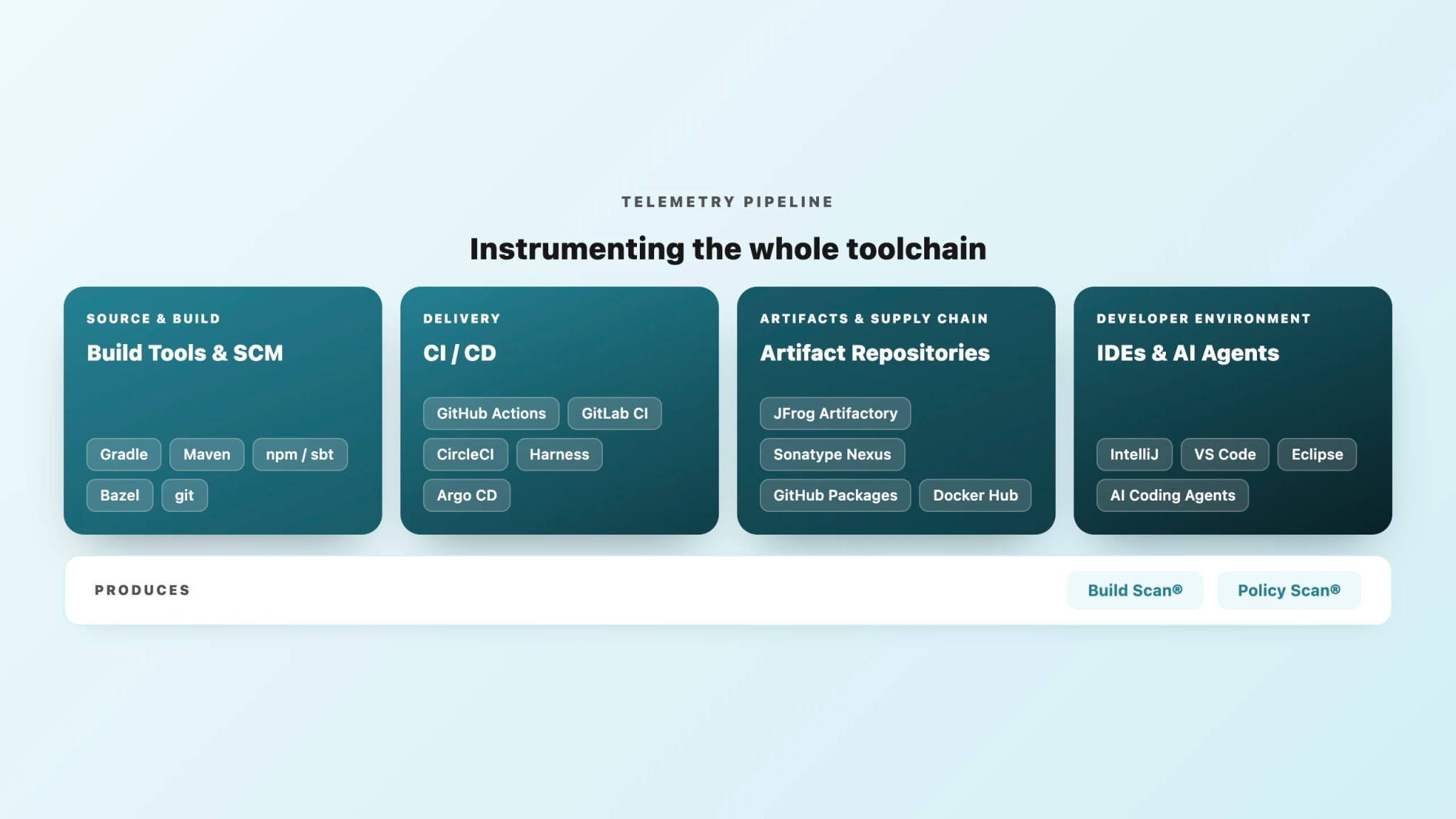
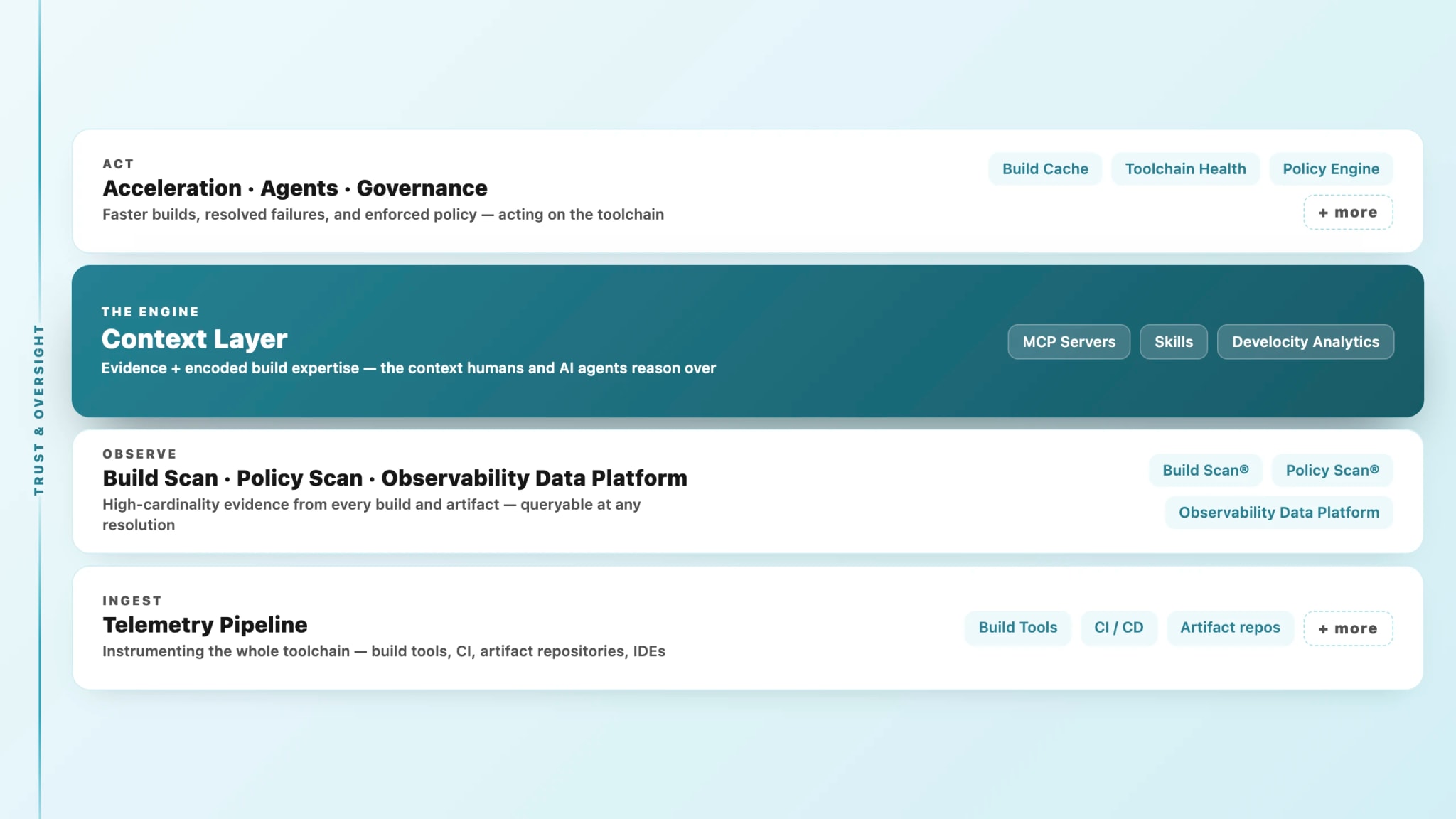
How Develocity works: a stack from the telemetry pipeline through the Context Layer engine to action, with trust spanning every layer.

Feature overview

How Develocity Works

Develocity is one platform organized as a loop over your software delivery toolchain — not a dashboard on top of it. It observes every build, test, and dependency as rich, queryable evidence; turns that evidence into shared context through the Context Layer, the engine that pairs that data with a decade of encoded build expertise; and acts on it to make the toolchain faster, healthier, and governed. Each layer feeds the next; every output is citable and overridable, with humans on the loop. The sections below walk the platform one layer at a time — and link to where each is covered in full.

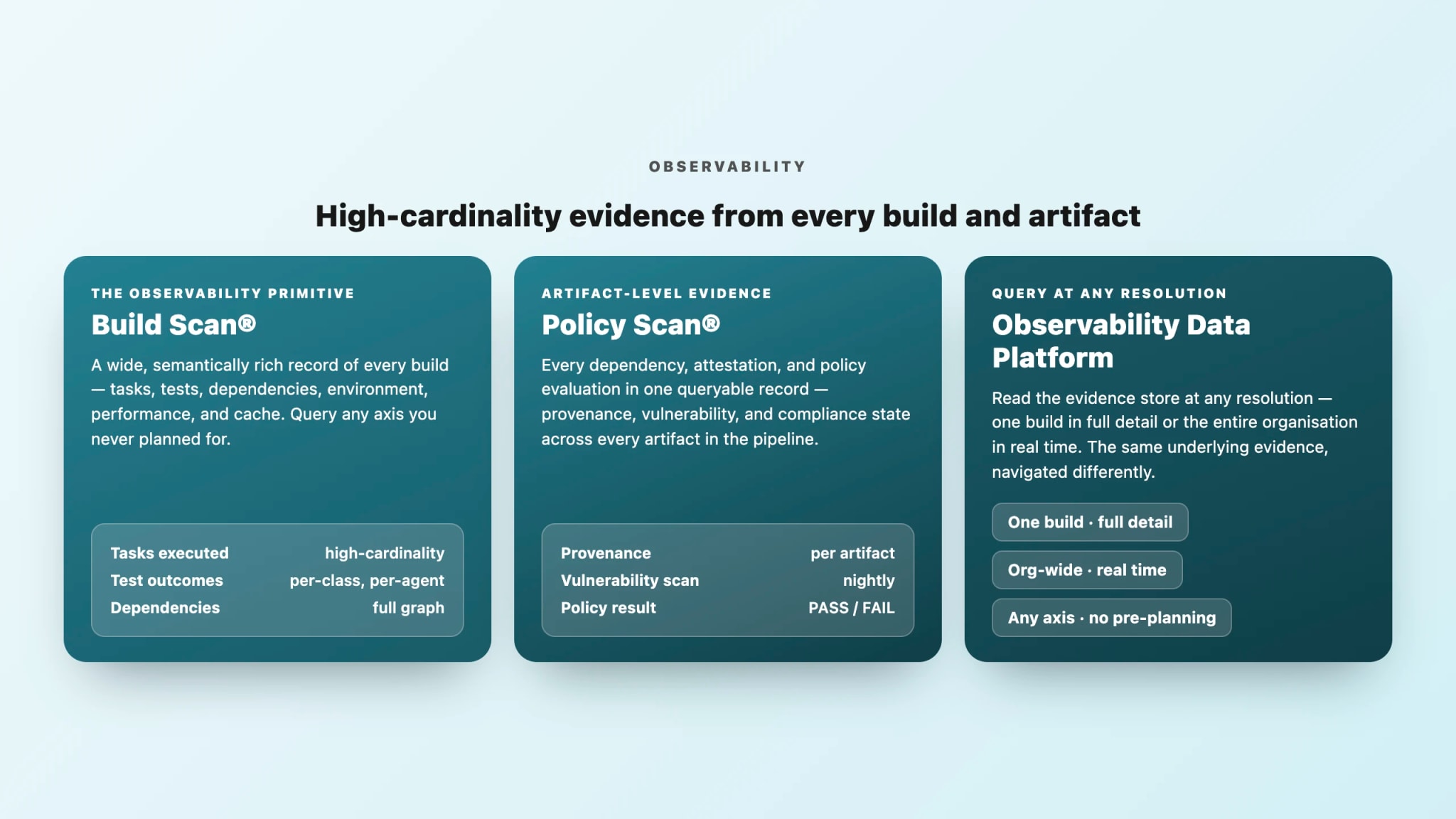
A high-cardinality evidence model, not logs — observability over every build and artifact

  • Every Build Scan and Policy Scan is a wide, high-dimensional, semantically rich event — the observability primitive for the toolchain, like a trace for a distributed system.
  • High cardinality is the payoff — query an axis you never planned, and isolate the exact commit, dependency, or CI agent, not a bucket. Observability, not a dashboard.
  • Read at any resolution — one build in full, or the whole organization in real time through the Observability Data Platform.
Observability layer — Build Scan and Policy Scan as the queryable evidence model.

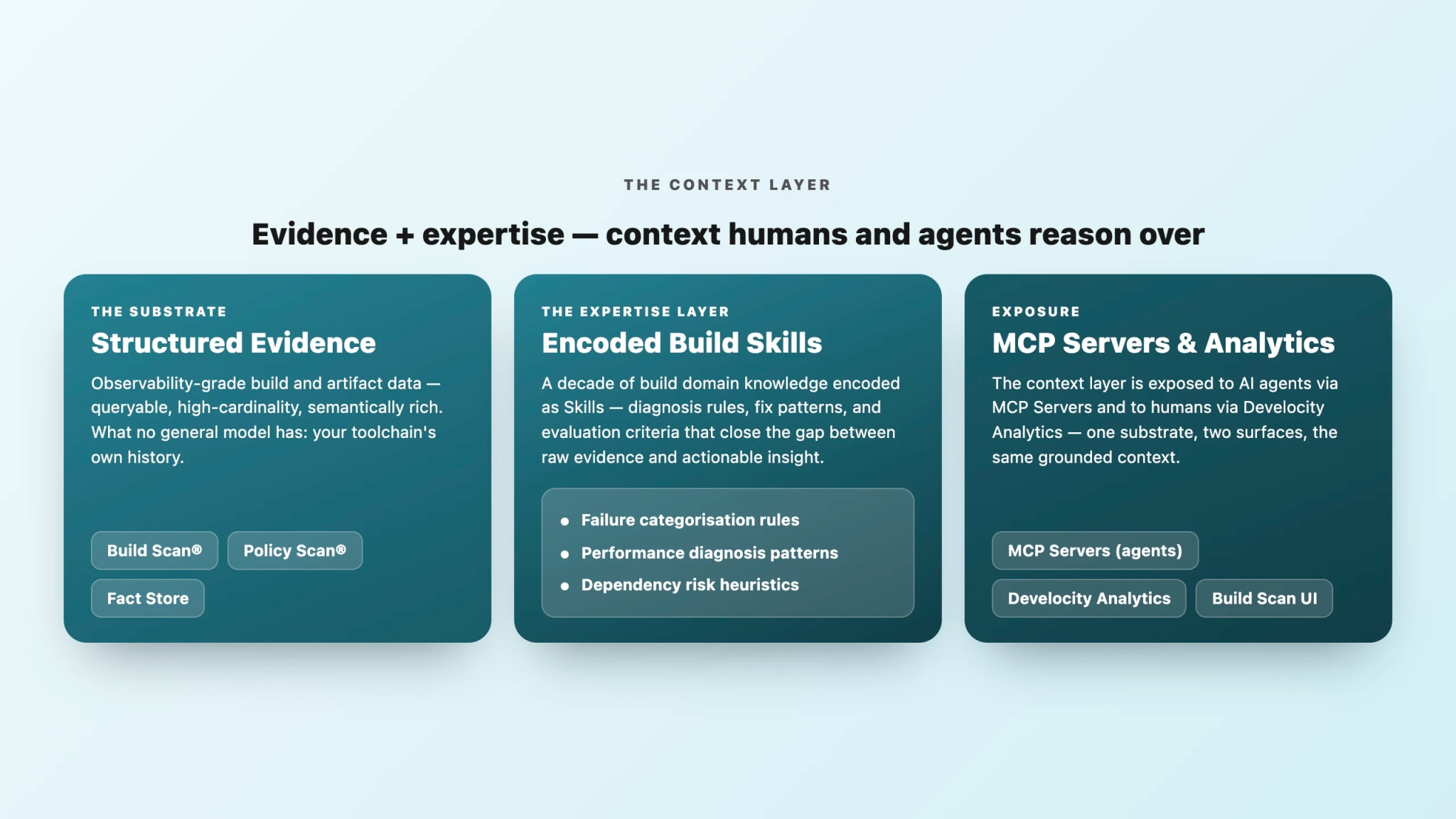
The engine that turns evidence into context humans and agents reason over

  • Evidence becomes usable context here — the Context Layer pairs that observability-grade data with a decade of encoded build expertise, exposed through MCP servers and Skills.
  • What no model has on its own — semantically rich evidence plus encoded build expertise exists only where Develocity captures it, not in any training corpus.
  • One source for humans and agents — the context behind a dashboard is the context an agent queries, so insight and automation never diverge.
Context Layer — the engine pairing evidence with encoded expertise.

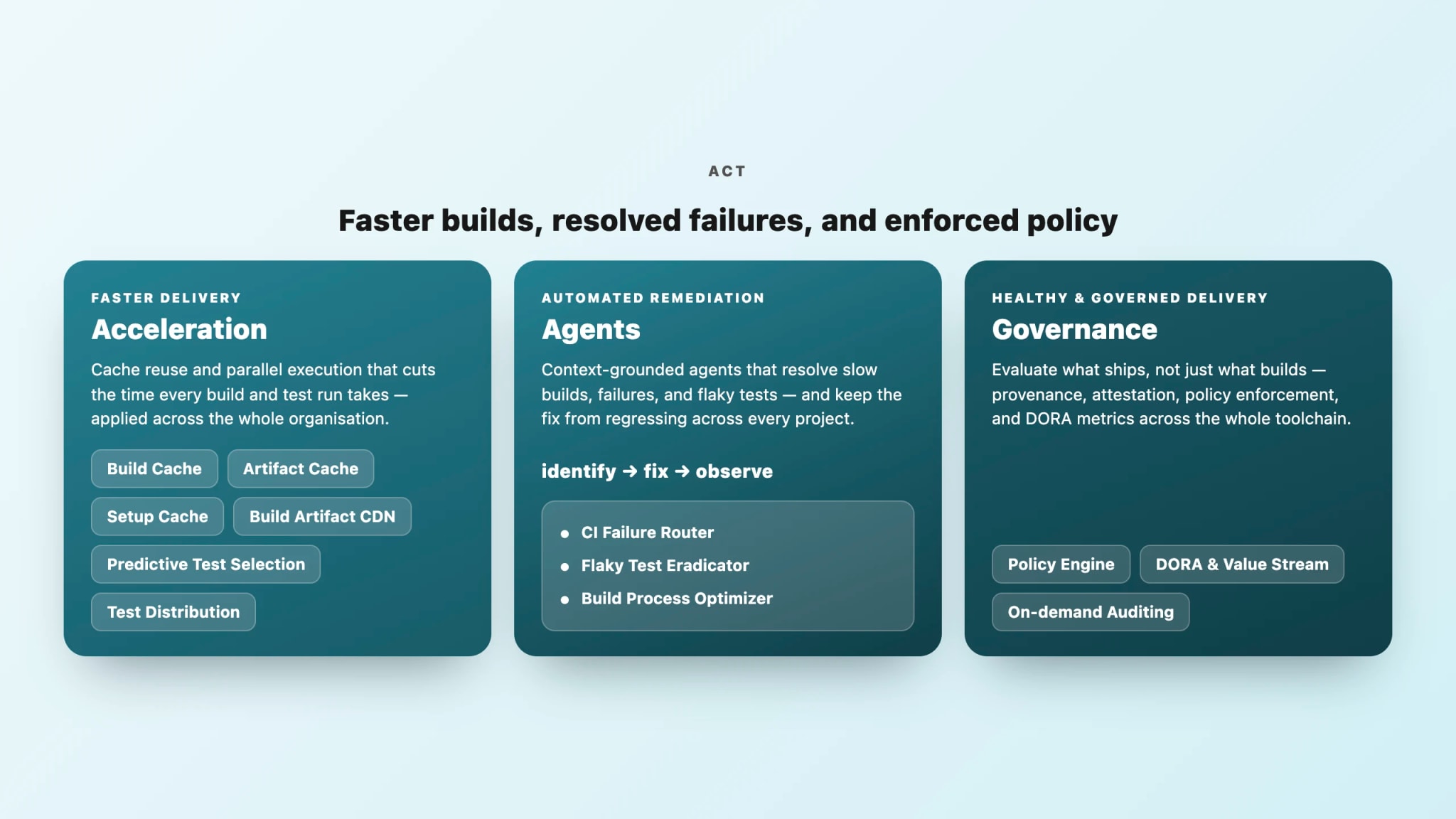
Develocity acts on the toolchain — faster, healthier, and governed

  • Acceleration engines — Build Cache, Test Distribution, and Predictive Test Selection cut the time every build and test run takes.
  • Agents — Develocity Agents run the Identify → Fix → Observe loop: they resolve slow builds, diagnose the failures and flaky tests behind red builds, and keep each fix from regressing across every project.
  • Policy engines — evaluate what ships, not just what builds: provenance, attestation, and auditing; the depth lives in the Security & Compliance pages.
Act layer — acceleration engines, agents, and policy engines acting on the toolchain.

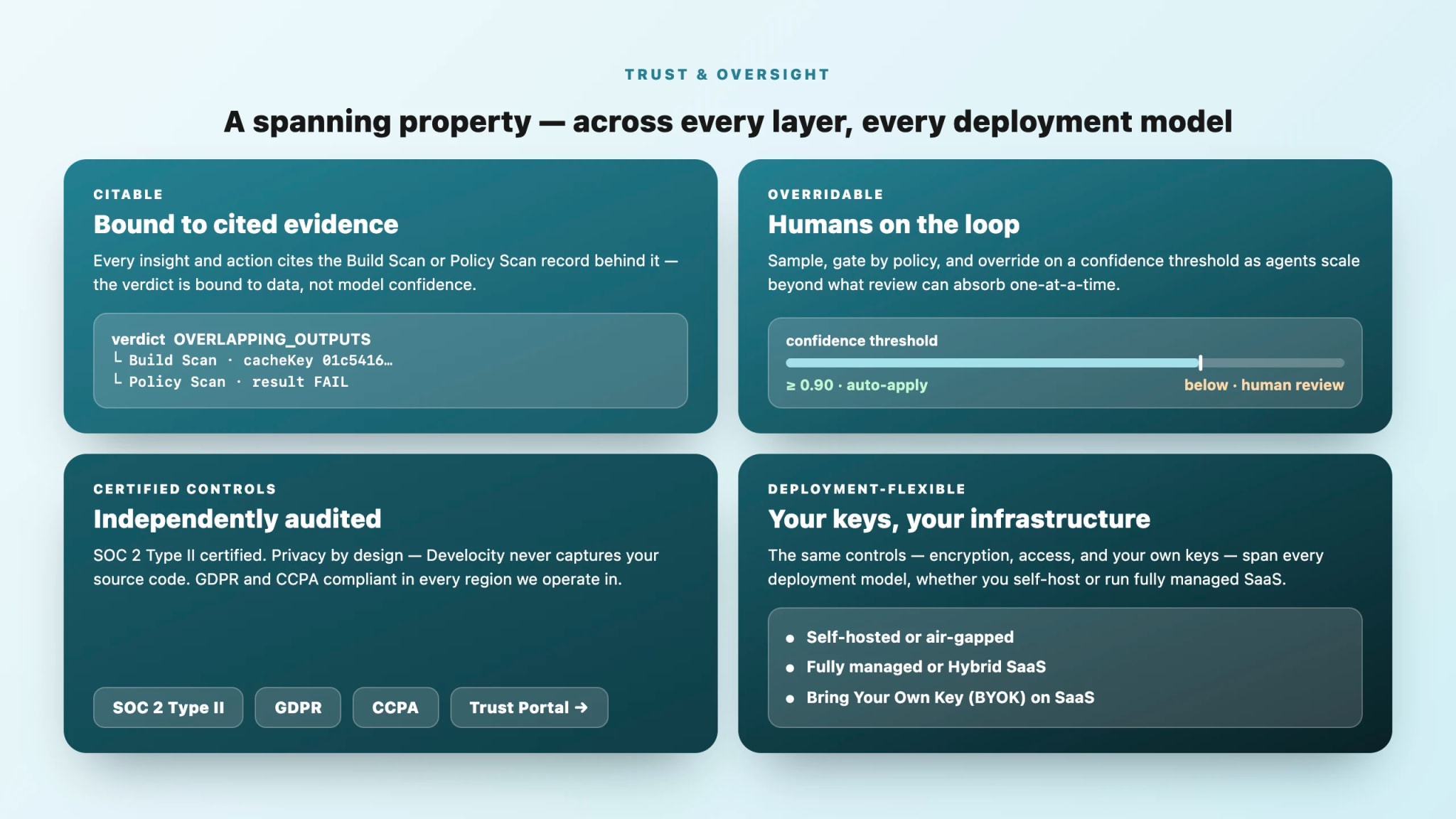
Trust spans every layer — citable, overridable, human-on-the-loop

  • Trust isn't a layer, it's a property of all of them — every insight and action cites the evidence behind it, so recommendations are checkable.
  • Humans on the loop, not in it — sample, gate by policy, and override on a confidence threshold as agents scale.
  • Controls that span every deployment model — access controls, encryption, and your own keys for agent actions, on SaaS or self-hosted. See Security & Compliance and Deployment Options.
Trust spanning every layer — citable, overridable, human-on-the-loop.

What's next

Get started today with a 30-day free trial of the entire Develocity product suite.

Start Free Trial

© 2026 Gradle, Inc. Gradle®, Develocity®, Build Scan®, and the Gradlephant logo are registered trademarks of Gradle, Inc.

Get an AI summary of Develocity: