Gradle Technologies is now Develocity — read the announcement

Efficiency

Get more out of everything your delivery already pays for — compute, tokens, AI agents, and developer time — without asking teams to ship less or wait longer.

Trusted by leading tech and global business brands

OpenAI
Airbnb
Wise
SoundCloud

Turn your AI investment into shipped software

AI is one of the largest new line items in the engineering budget — model access, tokens, the compute agents trigger, and the people who supervise them. The return on it is not how much the agents generate; it is how much of that spend ends up as software that ships. Today a large share doesn't: agents loop on flaky failures, abandon tasks they can't diagnose, collide with each other on merge, or ship regressions that get reverted — all of it billed, none of it landed. Loop quality is a key lever on how much of that investment converts into merged work. Context Engineering and its MCP Servers give each agent the build and failure context to fix what broke instead of guessing at it across repeated runs; Build Failure Agent lets it self-correct rather than abandon; and Flaky Tests Detection keeps it from chasing — or shipping around — failures that were never real. The merge collisions are a feedback-speed problem: Universal Cache, Predictive Test Selection, and Test Distribution shorten the loop so each change merges before parallel agents collide with it — and the slower the loop, the more collisions you pay to untangle. Artifact Governance tracks which agent-initiated changes reached production — the realization rate — and how much of your AI spend never ships. The full case for the AI program's return lives on AI.

The Build Caching Optimizer's run report — 3 issues found and fixed, warm rebuild 1m10s to 12.4s, cache hit rate 63% to 100% — with a before/after table and findings.

Get more out of your compute spend

CI compute leaks three ways at once: work you've already done gets redone, builds that fail on a flaky test or a brittle toolchain get rerun, and the machines you pay for sit half-idle. Universal Cache reuses build outputs, dependencies, and toolchains so settled work isn't recomputed, and Predictive Test Selection runs only the tests a change touches. Flaky Tests Detection and Develocity Agents cut the flaky-test and toolchain failures that force reruns, so you don't pay twice to verify a change that was fine all along. And Performance Insights goes after a different kind of waste entirely — idle cores, disabled parallelization, an over-provisioned machine — with agents acting on it, not just charting it. Every lever reclaims the same budget: more delivery from the CI spend you already carry, not a bigger bill.

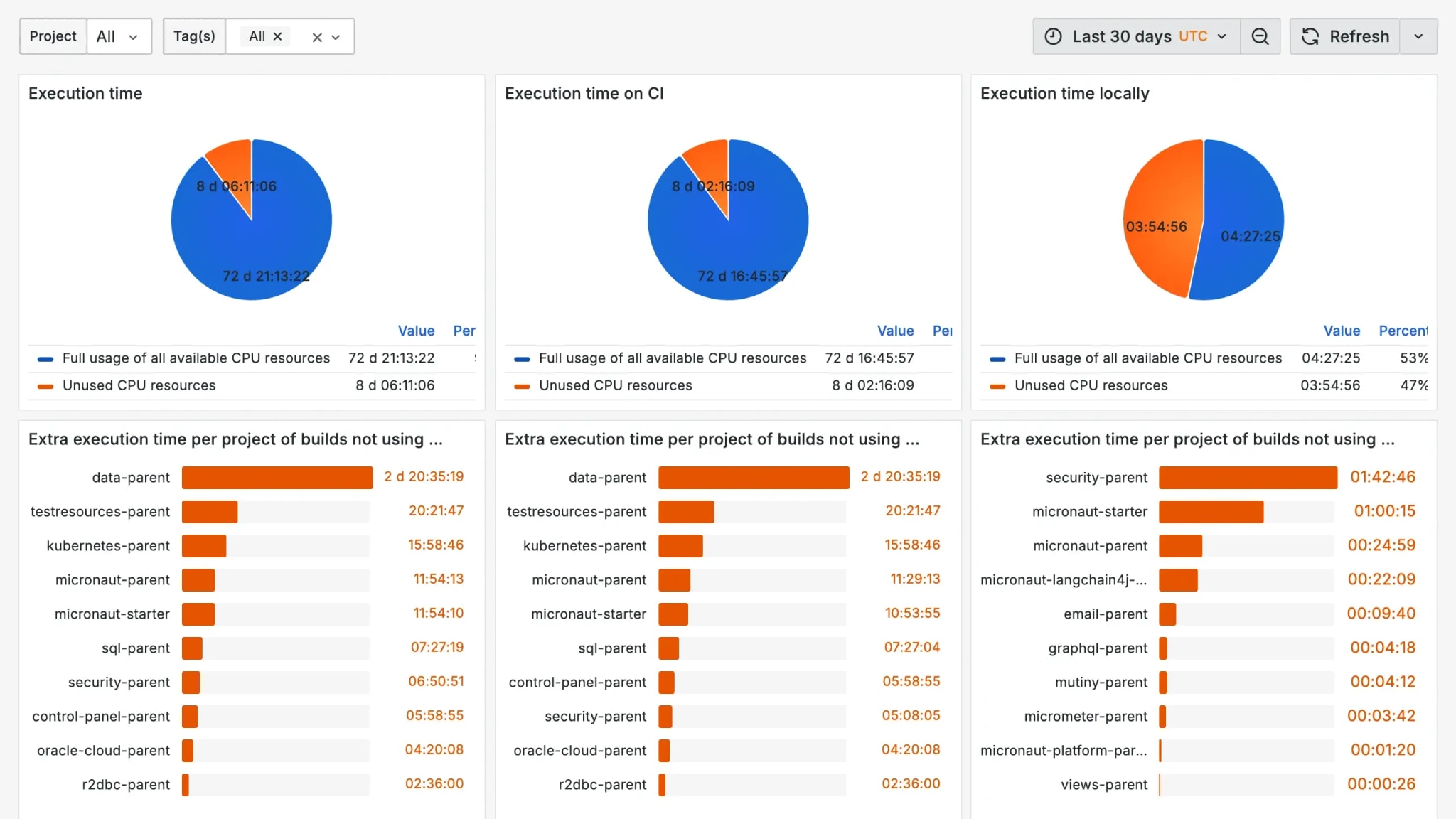
Develocity Analytics CPU Usage dashboard showing full-versus-unused CPU across builds and the extra execution time per project from builds that don't use all available CPU.

Get more out of your token spend

Every token an agent spends is a hard dollar, whether it lands a merge-ready change or just churns — and as you run more agents, that bill rises right along with the output. A significant share of that spend is waste: an agent reasoning over raw logs ingests tens of thousands of low-density lines, chases false paths, and re-runs builds to reproduce what the logs never captured. Build Scan gives the agent a wide, queryable record to read the cause from, Context Engineering and MCP Servers bound what enters its context, Build Failure Agent hands it the cause instead of a log to re-derive, and Flaky Tests Detection stops it debugging failures that were never real. The cost per shipped change falls and holds as you add agents, so output can grow faster than the bill.

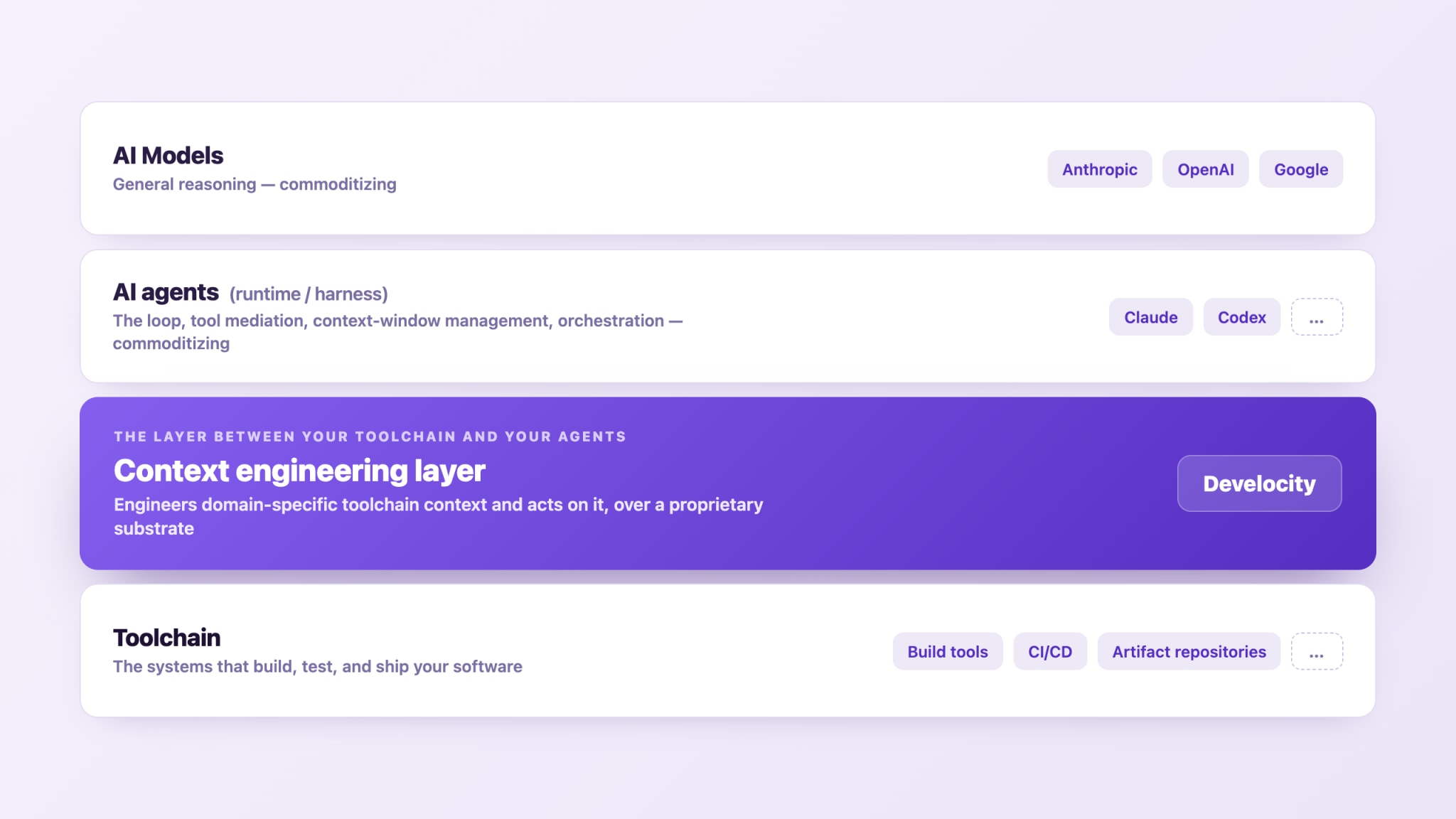
The customer's AI stack as four layers: AI models, AI agents (the runtime), the context engineering layer (Develocity, highlighted), and the toolchain.

Get more out of your developers' time

Developer time is the most expensive capacity your delivery has, and much of it never reaches product work, draining into waiting on builds and tests, chasing failures the change never caused, and diagnosing what broke. Universal Cache and Predictive Test Selection cut the wait between change and trusted result, and Test Distribution fans the rest across a pool of agents, so engineers stay in flow. Flaky Tests Detection quarantines non-deterministic tests so they stop failing builds that were fine; when a build does break, Build Failure Agent takes a developer from it failed to the root cause over the build record, not a manual hunt across logs. Develocity Agents keep that loop fast as the codebase grows. The reclaimed hours come back as engineering capacity — including faster, more reliable delivery; see DORA.

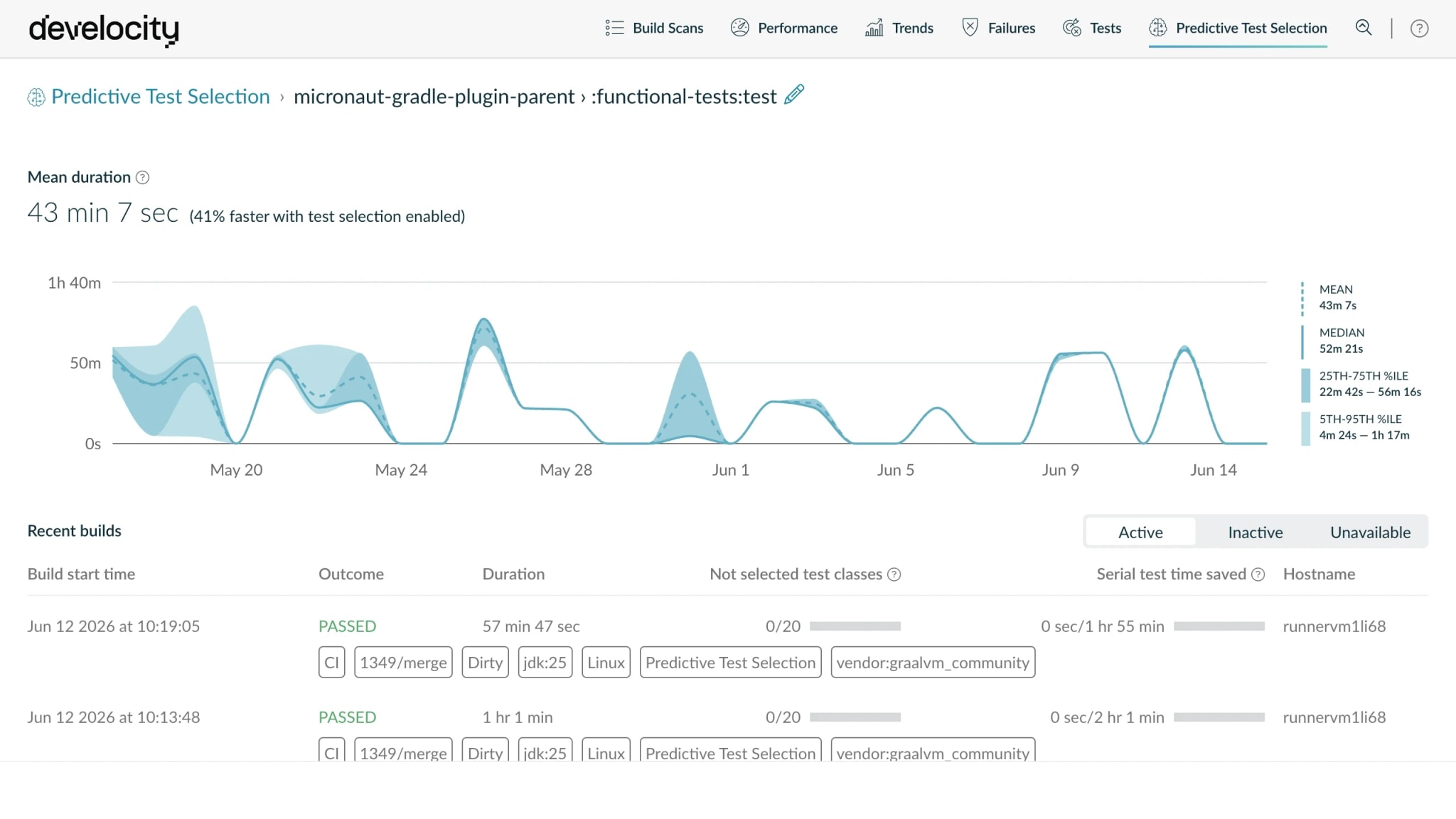
Predictive Test Selection view for a single test task — mean duration with a percent-faster delta, a duration trend, and serial test time saved per build, showing the developer wait between change and result collapsing.

Featured content

DevCloud acceleration at Elastic: ~200,000 build-agent hours saved a year
Case study
How DuckDuckGo cut their Android build times by up to 57%
Case study
Optimize your Gradle, Maven, sbt, and Bazel builds with resource usage data
Blog

© 2026 Gradle, Inc. Gradle®, Develocity®, Build Scan®, and the Gradlephant logo are registered trademarks of Gradle, Inc.

Get an AI summary of Develocity: