Gradle Technologies is now Develocity — read the announcement

Observability Data Platform

Where every build your organization runs lands — each Build Scan ingested at scale, persisted without limit, and served back in seconds.

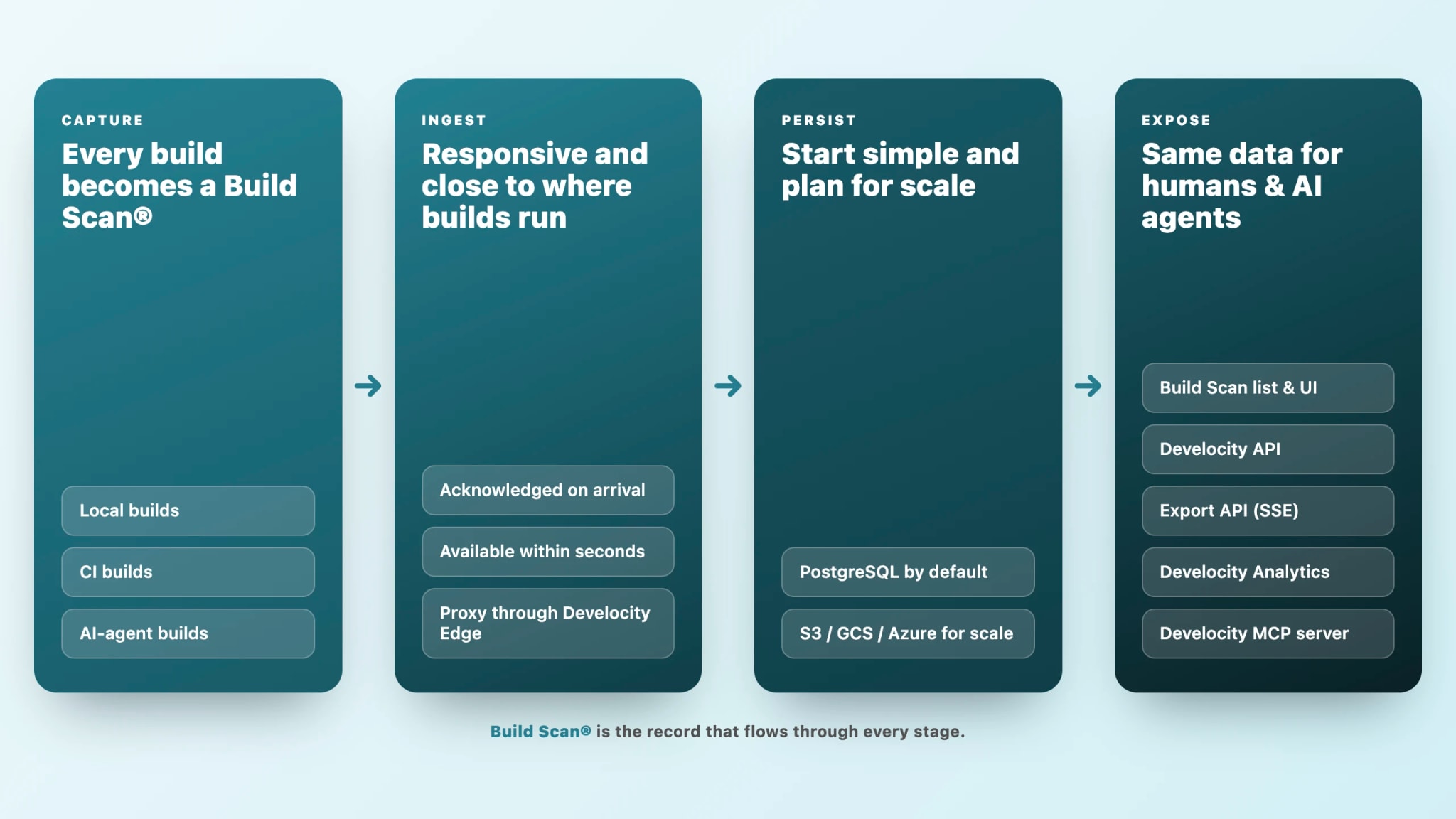
The Observability Data Platform pipeline — every build becomes a Build Scan, ingested through Develocity Edge, persisted to a PostgreSQL database or object storage, and exposed through the Build Scan list, UI, Develocity API, and Export API for both Develocity Analytics and the Develocity MCP server.

Feature overview

Observability Data Platform

The Observability Data Platform is where every Build Scan lands — the infrastructure tier that receives, persists, and serves the build records your organization produces. Local developer builds, CI builds, and AI-agent-triggered builds all arrive here, listed and queryable the moment each is processed. Incoming data is acknowledged on arrival and processed asynchronously — available within seconds; it persists to a PostgreSQL database by default, or to S3-compatible object storage for unlimited scale on AWS, Azure, or GCP. From there it is exposed for retrieval through the Build Scan list and UI, the Develocity API, and a Server-Sent Events Export API — and it feeds Develocity Analytics and the Develocity MCP server for AI agents. Build Scan is the data; this is the platform that receives, stores, and serves it.

Every build your organization runs lands here — local, CI, and agent alike

  • Each build lands in one list the moment it's processed — its origin tagged per row, so you filter CI, local, and agent runs at a glance.
  • Search the whole corpus with simple and advanced query — by project, tag, outcome, or custom value — automatically scoped by Project-Level Access Control (PLAC).
  • Open any single build as a full Build Scan — the deep-linked, shareable per-build view, one click from the list.
The Develocity Build Scan list filtered by an advanced query to failed test runs from local, CI, and AI-agent builds, showing runs across Gradle, Maven, sbt, npm, Python, and Bazel with build tool and version shown per row.

Ingest every build at organization scale without slowing one of them down

  • Each Build Scan is available within seconds — incoming data is acknowledged on arrival and processed asynchronously, so high inflow never bottlenecks ingestion or slows the sending build.
  • The pipeline absorbs both extremes — hundreds of thousands of Build Scans a day, and individual uploads over a hundred megabytes.
  • Route build data through Develocity Edge instead of every agent hitting the server directly — the Edge proxies uploads near where builds run, offloading the server.
  • Components scale horizontally for throughput and high availability — the ingestion path grows with load rather than capping it.
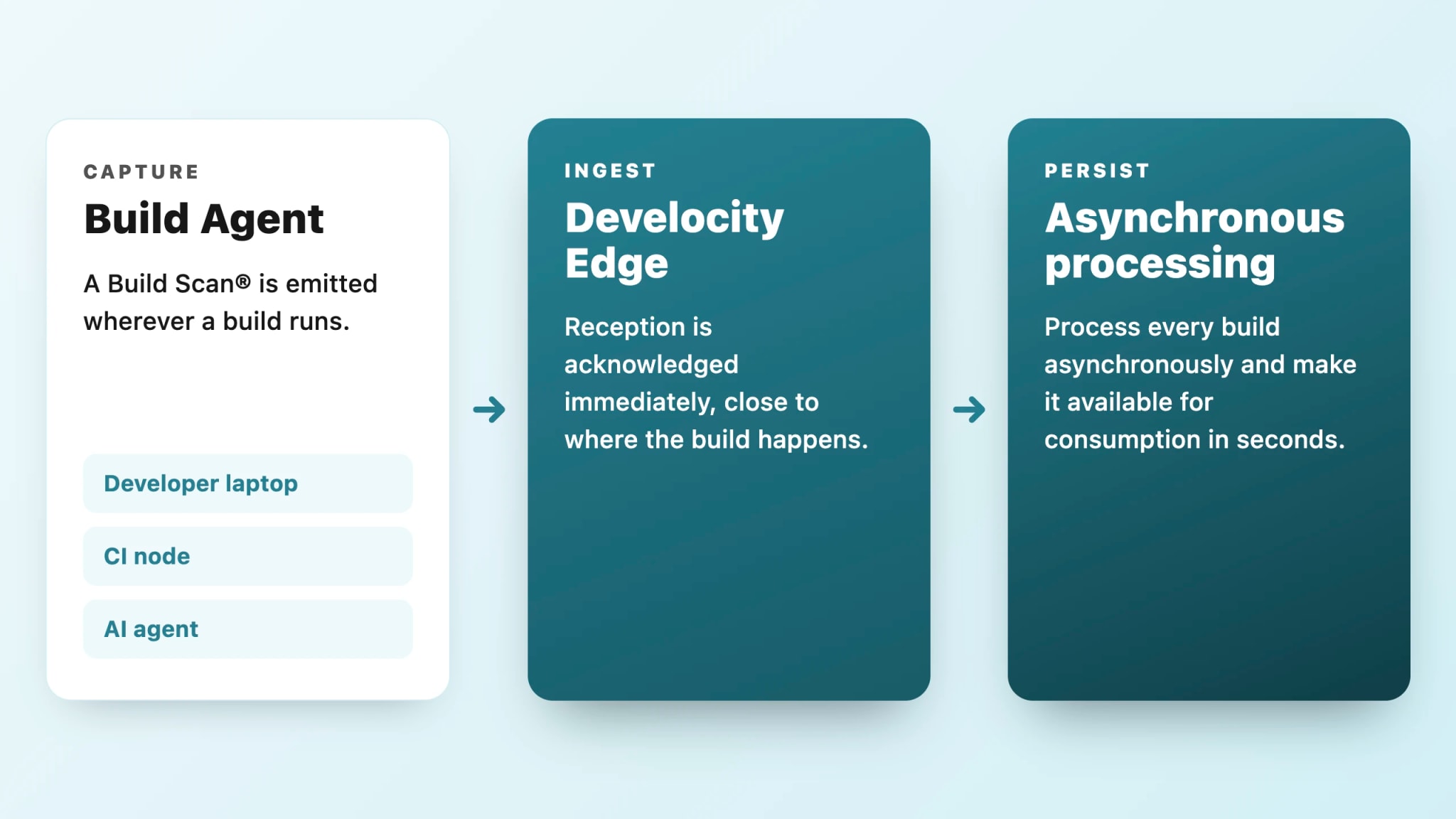
Ingestion flow — a Build Agent (developer laptop, CI node, or AI agent) emits a Build Scan to Develocity Edge, which acknowledges reception immediately close to where the build happens, then to asynchronous processing, which makes every build available for consumption within seconds.

Keep every build you've ever run, on storage that never fills up

  • Deploy with nothing extra to stand up — Build Scan data persists to a PostgreSQL database by default, no separate storage tier required.
  • Point Develocity at S3-compatible object storage — Amazon S3, Google Cloud Storage, Azure Blob, or any S3-compatible provider — and capacity scales without a ceiling.
  • Retention is yours to set — keep Build Scans indefinitely for long-range trends, or age them out automatically on a configured schedule.
  • Lifecycle tiering keeps it economical — Gradle cut its own Build Scan storage costs 75% by moving to object storage with cold-archive tiering for inactive Build Scans.
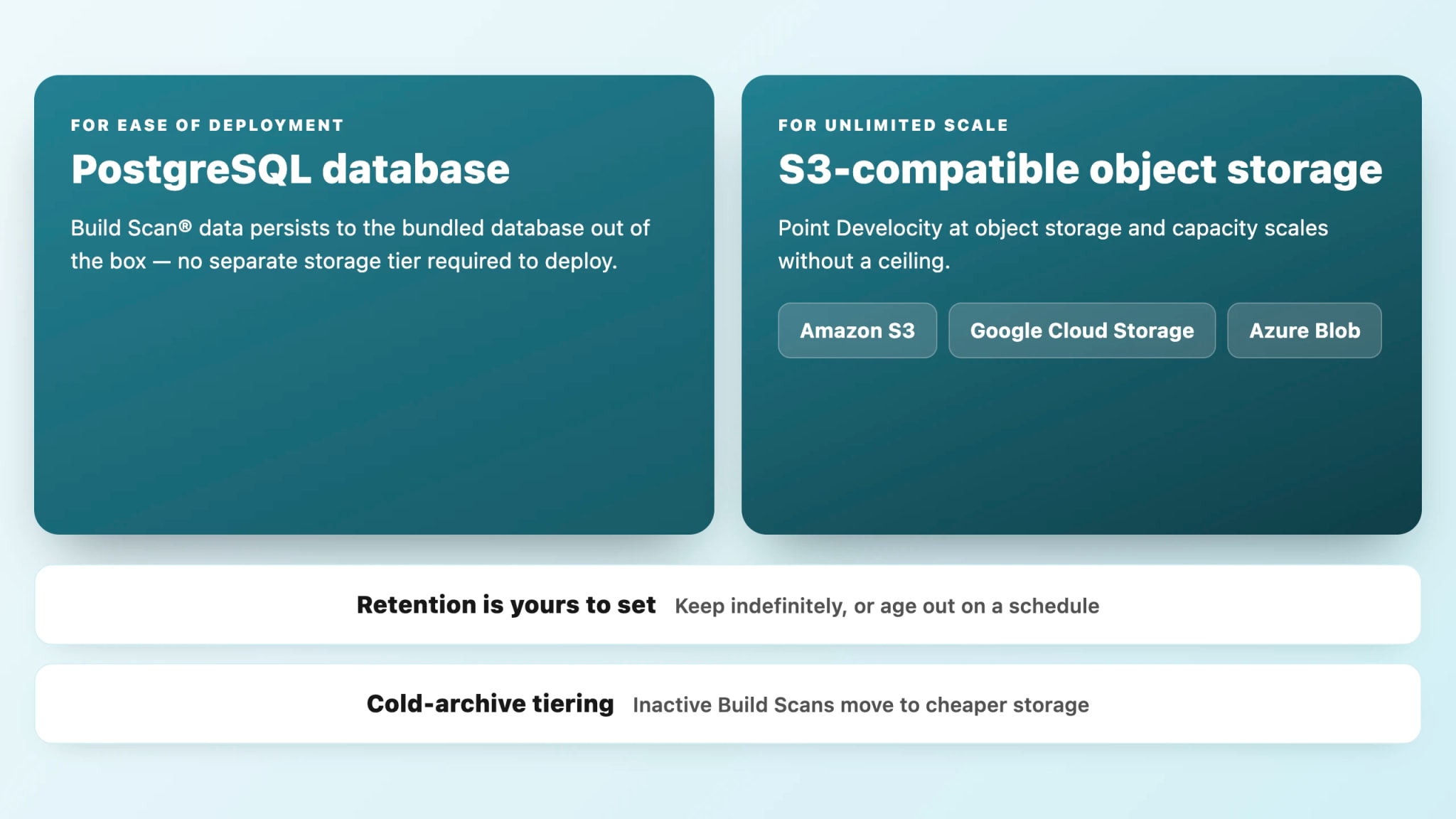
Build Scan data persisted to a PostgreSQL database by default or to S3-compatible object storage for unlimited scale, with configurable retention and cold-archive tiering.

Signed facts with Build Scan depth, across the supply chain

  • Complete provenance, captured at build time when the full dependency and toolchain picture is available.
  • Integrity you can verify at any point because every record is cryptographically signed at creation.
  • RoadmapStore provenance records in Object Store or JFrog Evidence (available today), or bring your own Fact Subscriber.
  • Every record follows an open standard, retrievable over REST or through object storage APIs.
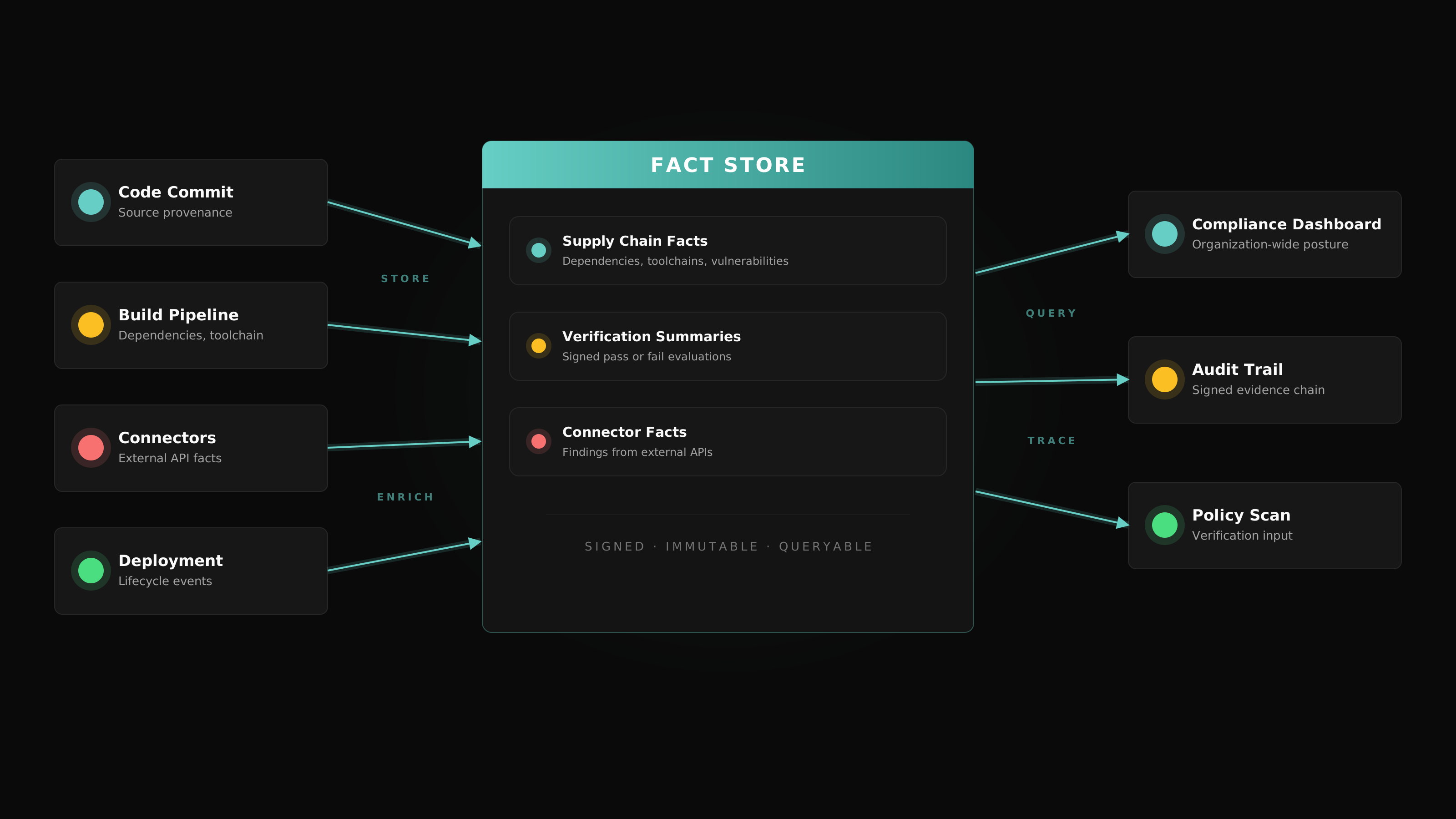
Artifact governance flow showing signed facts, Policy Scan evaluation at each gate, and on-demand compliance queries.

Pull any build's data, or stream new ones as they land

  • Poll the Develocity API for newly available builds — /api/builds takes the same advanced query language as the list and returns high-level, domain-enriched data.
  • Subscribe to the Export API's Server-Sent Events stream for low-level, raw per-build events as they arrive — evented, not polled.
  • Stream raw build data into your own systems, dashboards, or data warehouse — the platform is the source of record other tools read from.
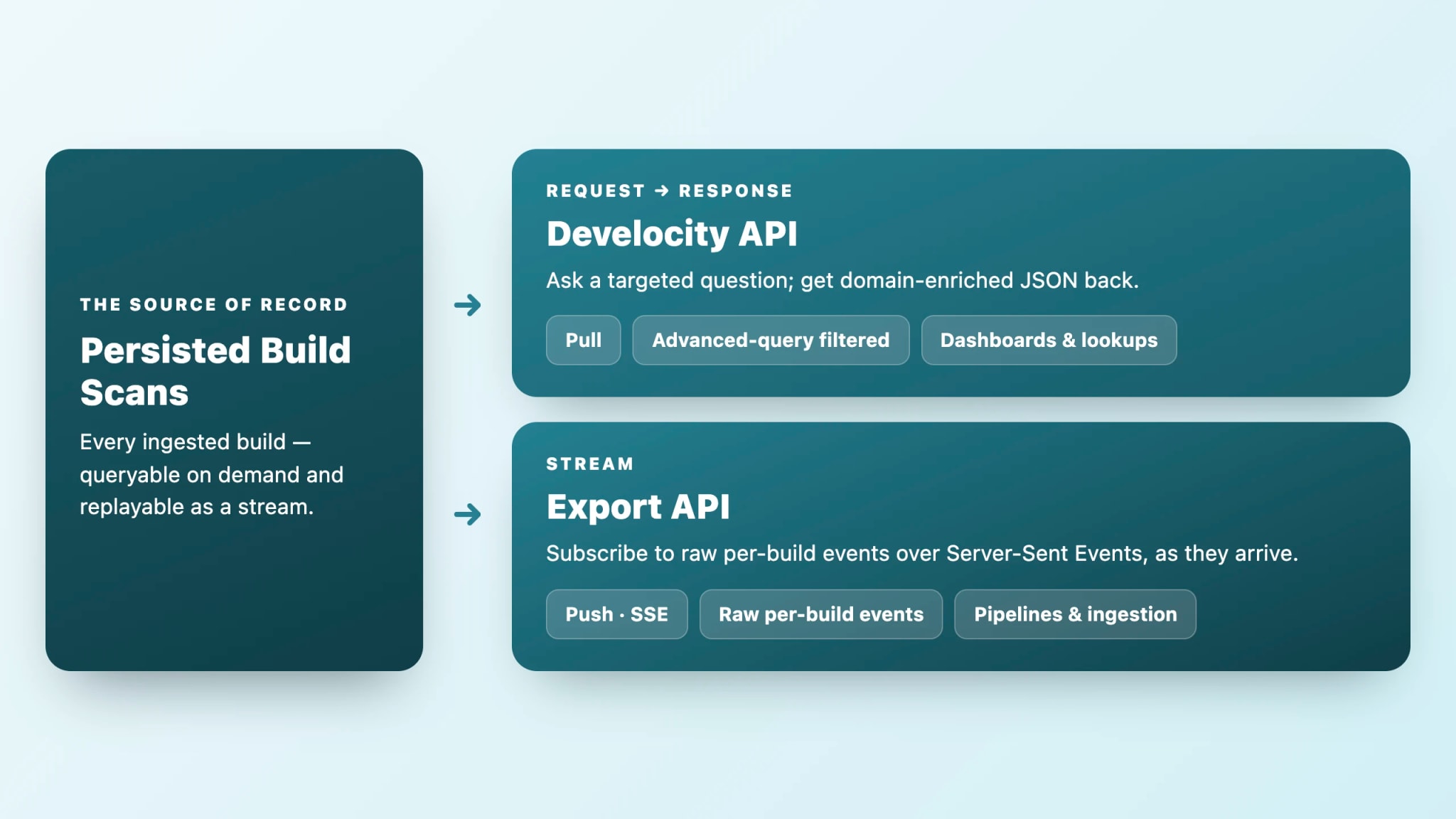
Two ways to read the platform from the same persisted Build Scan data — the Develocity API returns domain-enriched JSON on request, filtered with the advanced query language, while the Export API streams raw per-build events over Server-Sent Events as they arrive.
Agent Context

The same platform an AI agent queries to investigate a build

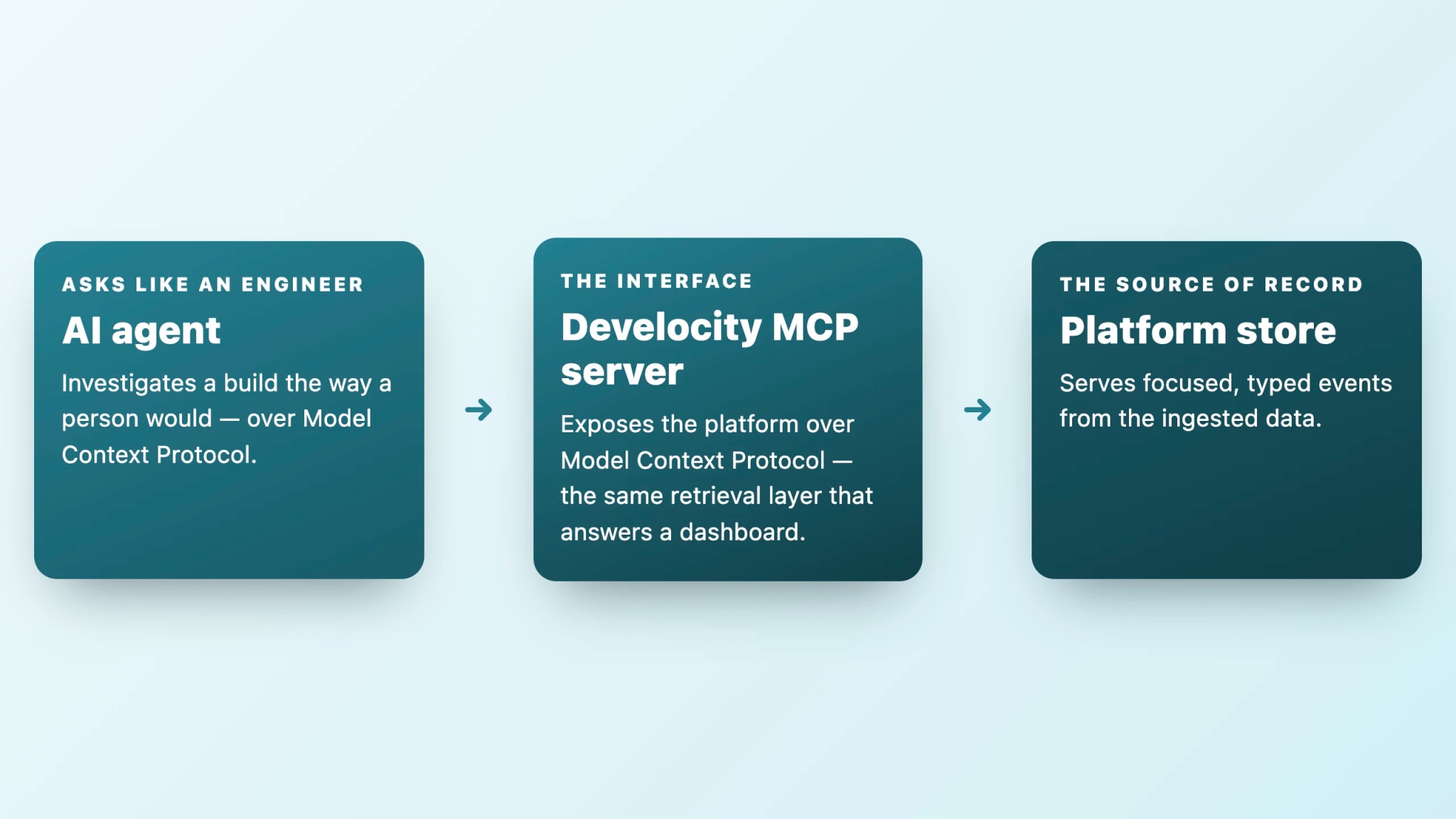
  • The Develocity MCP server exposes the platform over Model Context Protocol (MCP) — an agent fetches a build, compares two, and reads test results as an engineer would.
  • Agents read focused, typed events — outcomes, cache keys, failure causes — served from this platform's store instead of sifting megabytes of console output.
  • The retrieval layer that answers a dashboard answers an agent — the same ingested data, exposed over MCP and the API.
An AI agent reading build data from the platform through the Develocity MCP server.

Resources

How Gradle reduced Build Scan storage costs on AWS by 75%
Blog
New features in Develocity 2023.3 focus on enterprise scalability and mission criticality
Blog
Build Scan storage administration
Documentation
Develocity Export API
Documentation

What's next

Get started today with a 30-day free trial of the entire Develocity product suite.

Start Free Trial

© 2026 Gradle, Inc. Gradle®, Develocity®, Build Scan®, and the Gradlephant logo are registered trademarks of Gradle, Inc.

Get an AI summary of Develocity: