Gradle Technologies is now Develocity — read the announcement

AI

Turn AI coding from unaccountable spend into governed, productive, cost-efficient output — measured against the same build and test telemetry every change already produces.

Trusted by leading tech and global business brands

OpenAI
Airbnb
Wise
SoundCloud

Govern AI-generated artifacts with provenance

Auditors and security teams will ask what the agents shipped; with AI raising the volume of changes, the answer has to be on record by default. Policy Scan records what each agent built, from which inputs, by which process — so AI-authored changes carry the same signed evidence trail as human ones and violations are caught at the gate rather than after release. Artifact Governance persists those attestations as immutable records, so you can answer what an agent shipped long after the build environment is gone. The full provenance, audit, and policy case lives on Software Governance.
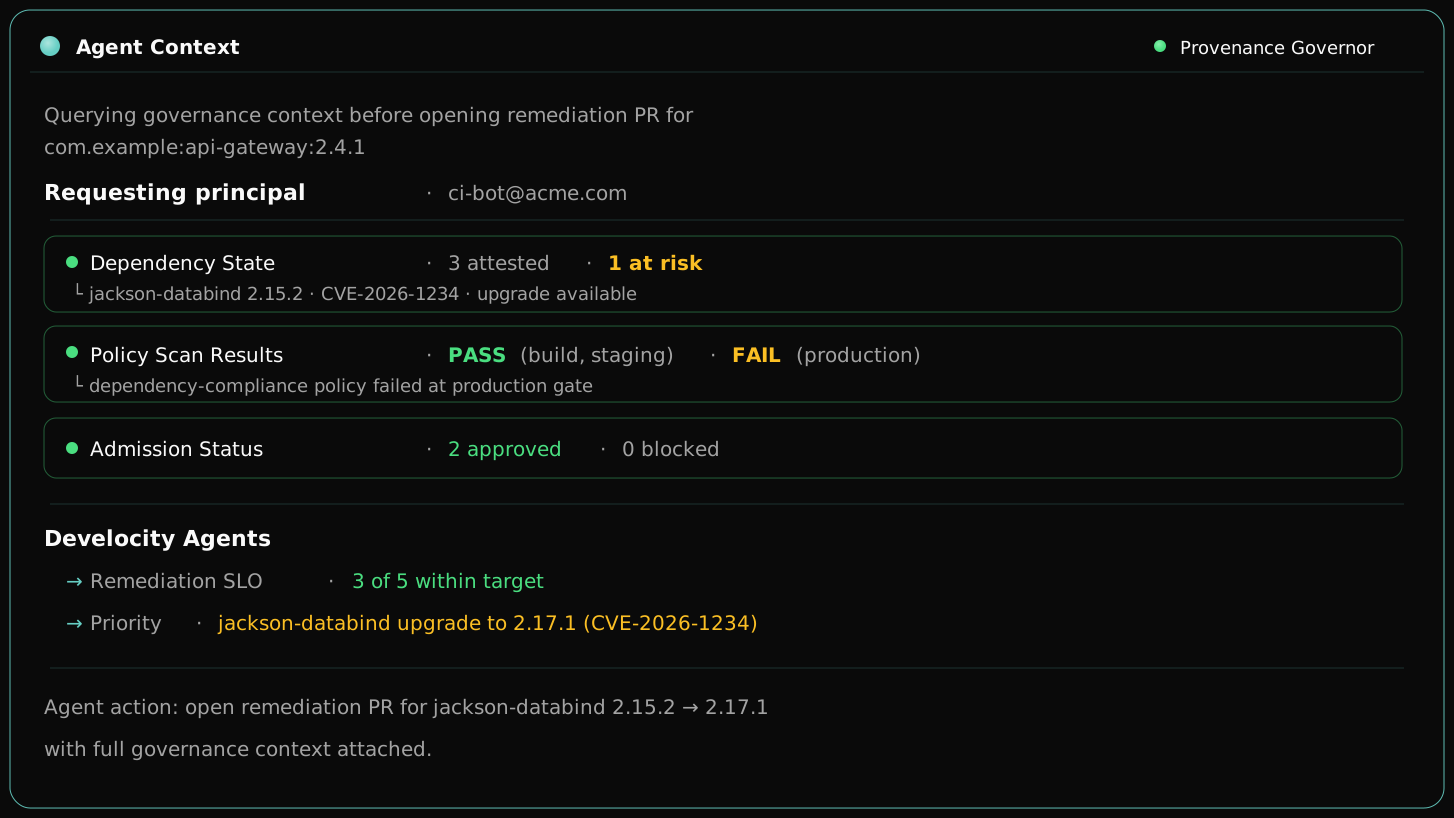
Agent Context view from the Provenance Governor: an agent queries governance context before opening a remediation PR — dependency state (3 attested, 1 at risk), Policy Scan results passing in build and staging but failing at the production gate, admission status, and the Develocity Agents remediation SLO

Improve agentic productivity with faster, reliable feedback

You bought the model; the loop it runs in decides how much it ships. A coding agent runs the same inner loop a human does, and what caps its output is not the model but how long each change takes to reach merge. Faster, more reliable feedback shortens it from every side. Universal Cache skips work already computed, Predictive Test Selection runs only the tests a change can affect, and Test Distribution parallelizes the rest, so each iteration returns in proportion to the change, not the codebase. Flaky Tests Detection keeps the pass-or-fail an agent acts on true, so it stops burning cycles on failures the change never caused, while Build Failure Agent hands it the cause to act on instead of a raw log to re-derive. Develocity Agents keep the loop fast and the signal reliable as agent volume climbs. The agent consumes all of it through the Context Engineering layer and its MCP Servers — machine-readable context, not a dashboard — and Develocity Analytics shows the merge-ready output gained and the wasted runs still on the table.

The Build Caching Optimizer's run report — 3 issues found and fixed, warm rebuild 1m10s to 12.4s, cache hit rate 63% to 100% — with a before/after table and findings

Reclaim the developer capacity AI's return depends on

AI made authoring faster, not validation. In most enterprises, validating a change still runs through people — developers review, steer, and integrate what AI generates. The constraint moves to the verification loop, so the AI program's return turns on how fast people clear it. An agent can wait on a build for free, but a developer supervises only so many agents at once, so feedback cycle time stays a hard limit on what a person can land. And when an agent can't fix a failing build itself, a developer must — diagnosing code they didn't write, where AI widens the comprehension gap. Universal Cache, Predictive Test Selection, and Test Distribution compress that feedback cycle; Build Failure Agent reads the cause off the Build Scan record so the developer doesn't have to. That reclaimed capacity is what turns AI output into shipped product, not an unvalidated backlog.

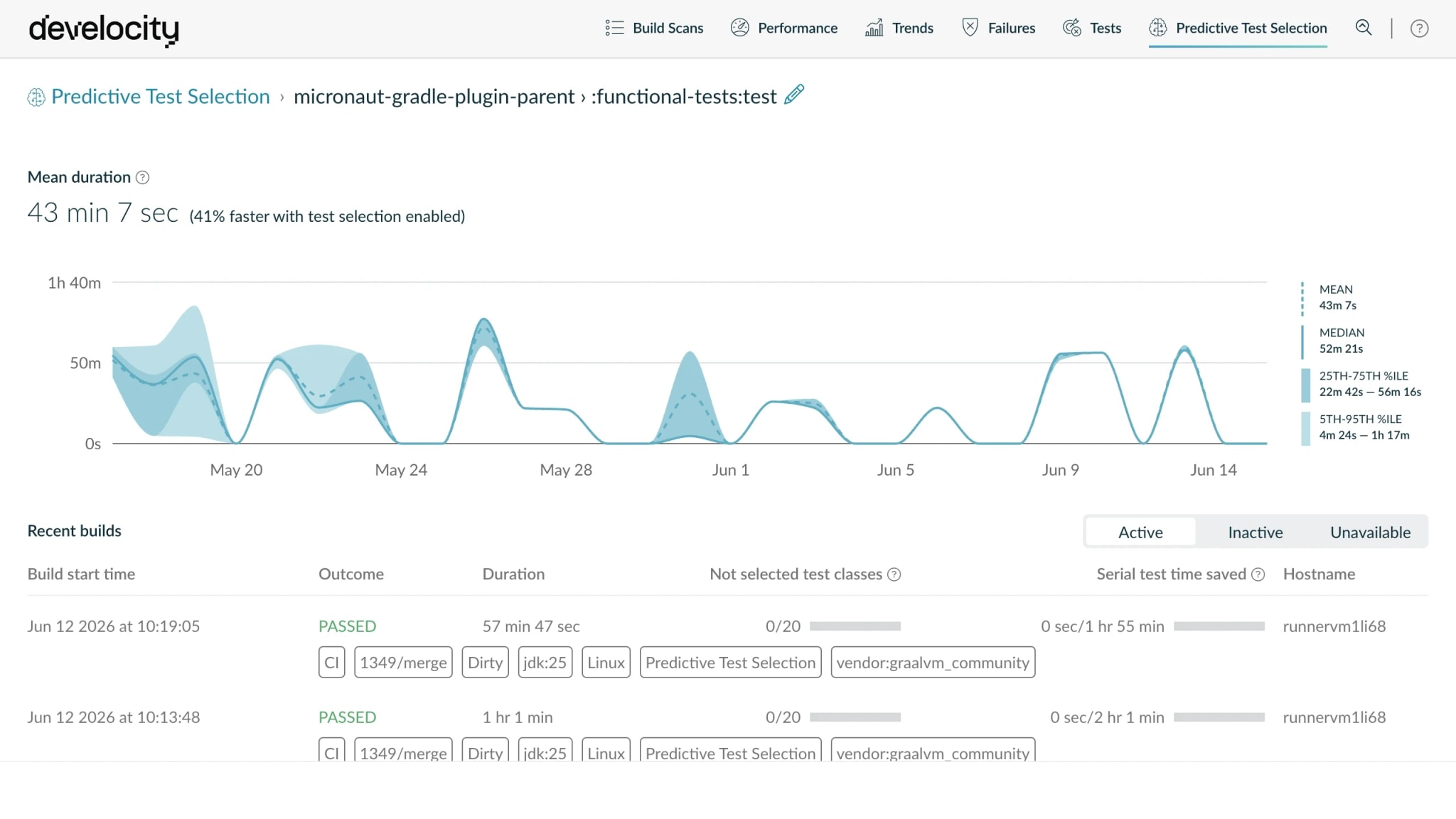
Predictive Test Selection view for a single test task — mean duration with a percent-faster delta, a duration trend, and serial test time saved per build, showing the wait between change and result collapsing

Cut AI token spend with context engineering

Even the best model can't diagnose what it can't see. Pointed at raw logs, an agent burns tokens reconstructing the state the logs left out and re-running jobs to reproduce what they never captured — capable reasoning spent on guesswork. Context Engineering gives it a wide, high-dimensional Build Scan record to query directly — the failing task, its inputs, the diff from the last green build — so it reads the cause instead of inferring it across repeated runs. MCP Servers keep each response bounded, and Build Failure Agent hands over the cause already resolved. Model and substrate compound rather than compete: the record gives the model truth it can't invent, and the better the model, the more it makes of it — so the tokens you save grow as models advance.

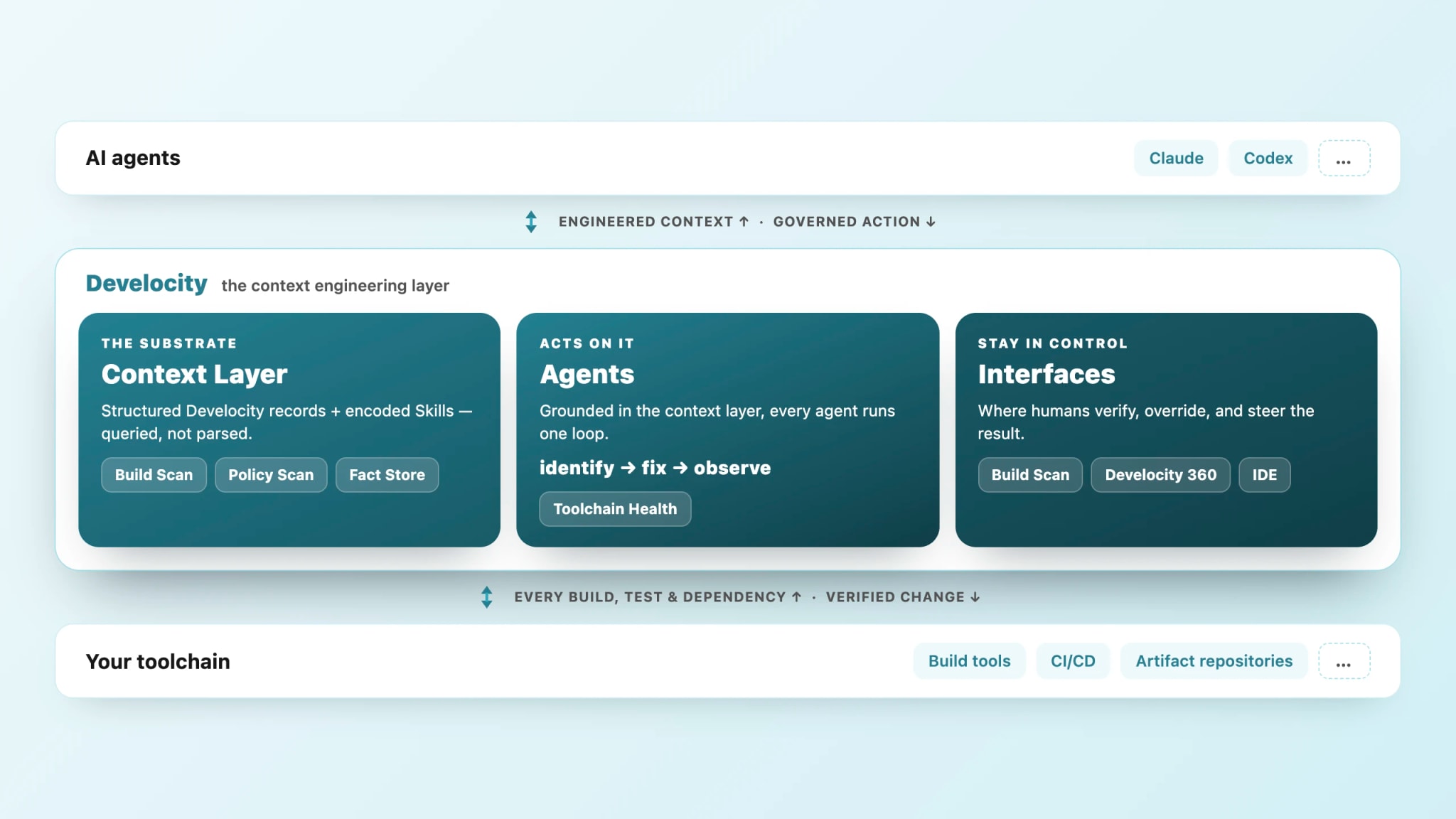
Diagram of the Develocity context-engineering layer between AI agents and the toolchain — the context substrate (Build Scan, Policy Scan, Fact Store), agents running identify-fix-observe, and human-control interfaces

Contain compute cost as AI build volume surges

Every AI-generated change triggers builds and tests, and agent commit volume turns CI into the fastest-rising line in the budget — left unchecked, it can eat the productivity the agents were bought for. The surge hits cold and hits twice: each ephemeral agent re-downloads its dependencies, and every flaky-test or toolchain failure across that volume gets rerun. Artifact Cache serves dependencies and toolchains from a co-located node at LAN speed instead of re-fetching over the WAN, Universal Cache skips outputs already computed, and Predictive Test Selection sizes test runs to the change. Flaky Tests Detection and Develocity Agents keep flaky-test and toolchain failures from piling up into reruns as volume climbs — so cost-per-build holds flat as the agent count rises. Develocity Analytics keeps the surge accountable by team and pipeline. The same levers carry the full case — see Efficiency.

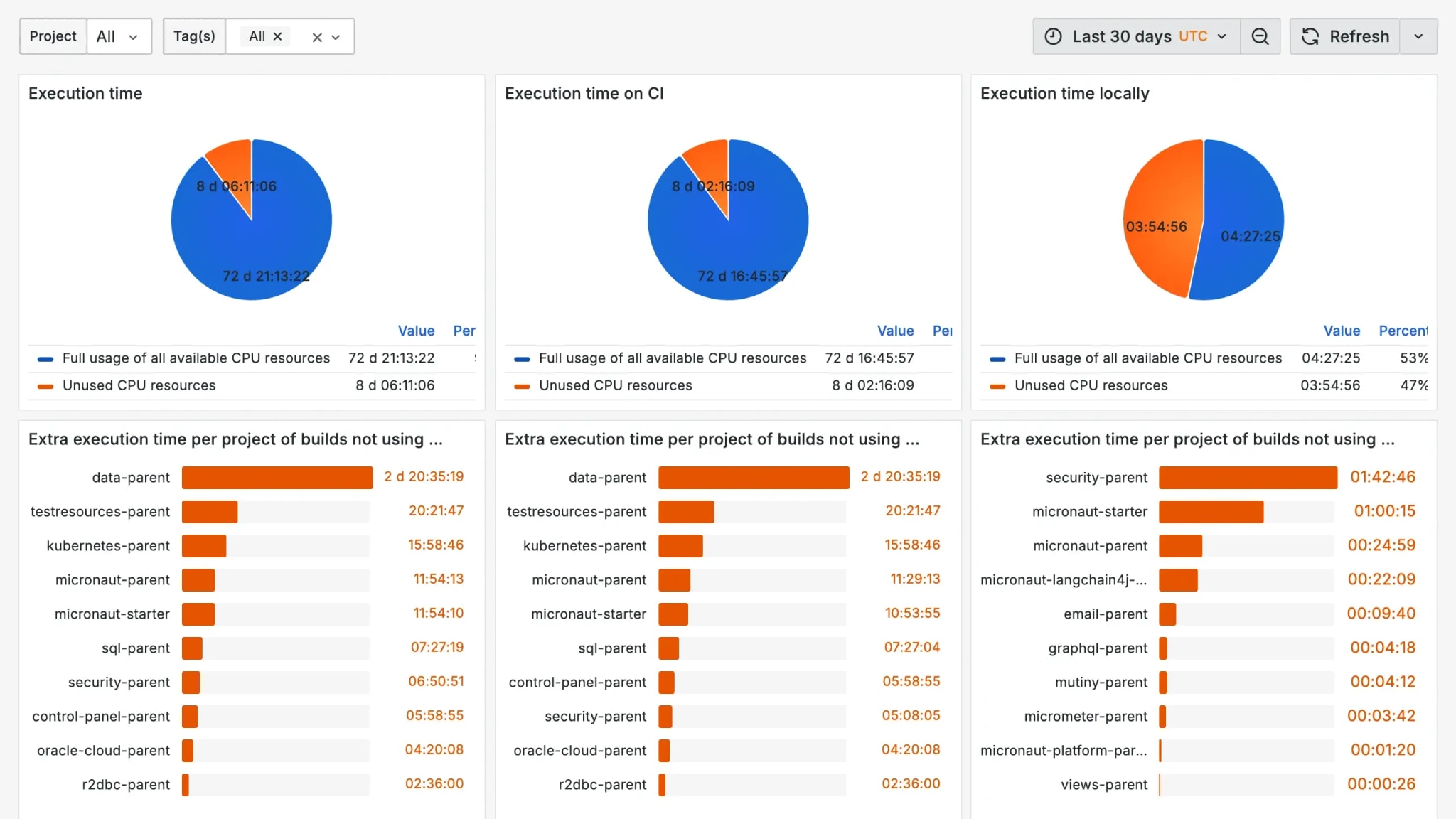
Develocity Analytics CPU Usage dashboard over 30 days — full-versus-unused CPU across builds (overall, CI, and local) and the extra execution time per project from builds that don't use all available CPU

Featured content

Netflix customer story: Develocity saves 280,000+ hours/year
Case study
Why pipeline acceleration is now a strategic imperative in the GenAI era
Blog
The Build Artifact CDN: strategic infrastructure for AI-driven DevOps
Blog
When AI code overloads CI, Universal Cache keeps builds fast and costs in control
Blog

© 2026 Gradle, Inc. Gradle®, Develocity®, Build Scan®, and the Gradlephant logo are registered trademarks of Gradle, Inc.

Get an AI summary of Develocity: