Gradle Technologies is now Develocity — read the announcement

Integrations

Connect Develocity to the CI servers, IDEs, observability tools, and AI agents your teams already run.

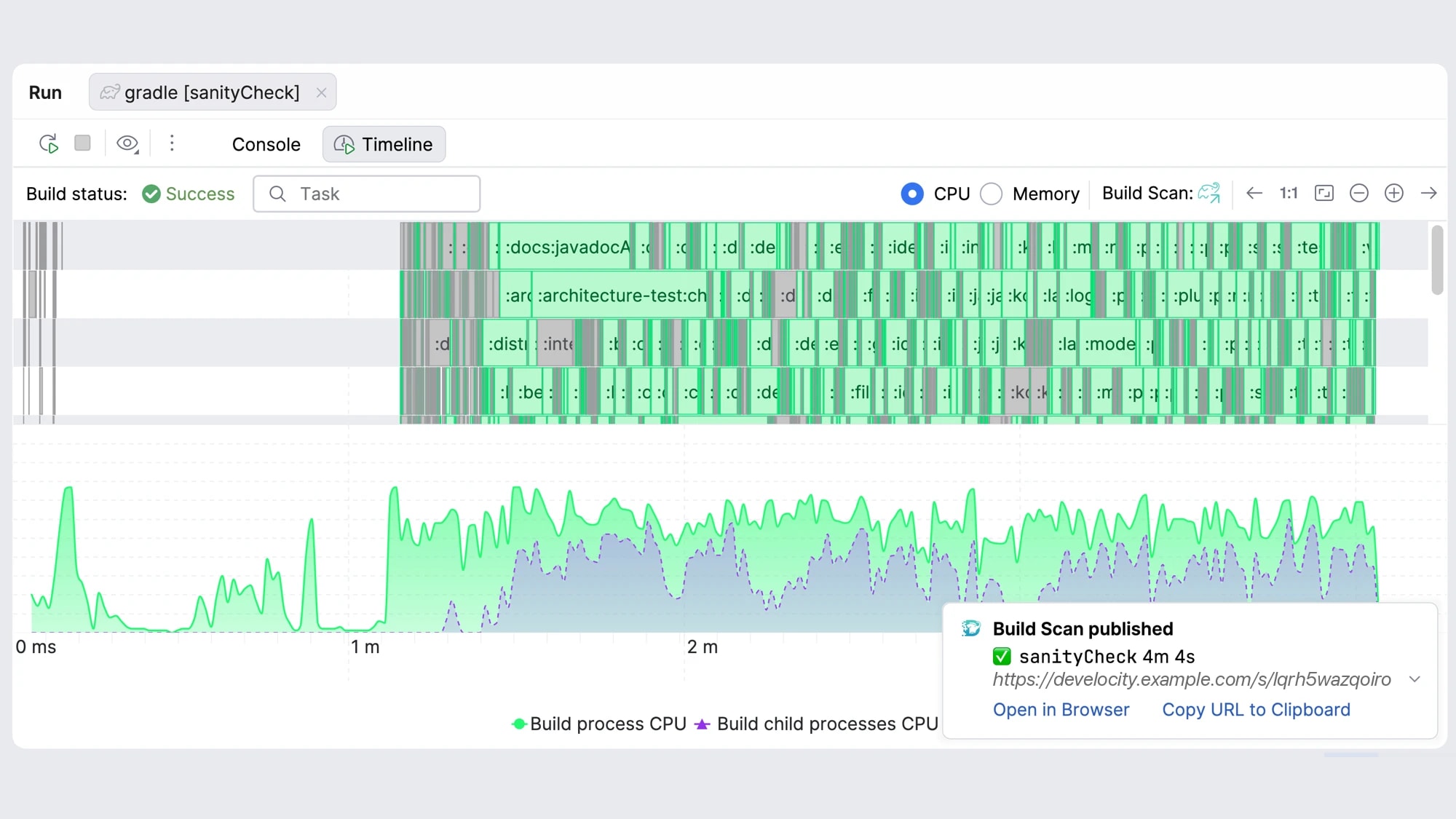
Develocity IntelliJ plugin showing a successful build's timeline with per-task CPU and memory, and a Build Scan published notification linking to the run's Build Scan.

Feature overview

Integrations

Integrations is the connectivity surface of Develocity — how it plugs into the toolchain your platform team already runs. Develocity runs inside every major CI server, links local builds to their Build Scan in IntelliJ, streams every build event out to Grafana, Splunk, or Datadog over the Export API, and exposes that same build data to AI agents over the Model Context Protocol. This is connectivity, not ingestion: what Develocity reads from — build systems, CI and IDE signals, and AI agents — is the Telemetry Pipeline surface. Where Develocity runs is Deployment Options; who may access it is Security & Compliance.

Integrates at the build level, so it runs in any CI system

  • Every CI just runs builds, and Develocity plugs in at the build level — so any CI system, self-hosted or SaaS, publishes a Build Scan from every run.
  • For Jenkins, GitHub Actions, GitLab, and TeamCity, maintained plugins inject Develocity without editing build scripts — so you roll it out across every job, not pipeline by pipeline.
  • Capture more about any CI run — provider, pipeline, and trigger — through metadata enrichment, the Telemetry Pipeline surface that reads from the same systems Develocity runs on.
A CI run summary listing each Gradle build job with its requested tasks, Gradle version, green outcome, and a published Build Scan link.

The build timeline, Build Scan, and test history — inside the IDE

  • Watch a local build live — the Develocity IntelliJ plugin charts every task and goal with its CPU and memory use as it executes.
  • On completion, a notification links straight to the run's Build Scan — open the full failure, timeline, and dependency detail without switching windows.
  • Test classes and methods carry inline pass/fail/flakiness history from your Develocity server, so a chronically flaky test is obvious in the file before you run it.
  • Plugin or not, every local build prints its Build Scan URL and records the IDE or command line that launched it — VS Code, Eclipse, or terminal alike.
Develocity IntelliJ plugin showing a successful build's timeline with per-task CPU and memory, and a Build Scan published notification linking to the run's Build Scan.

Stream it, query it, report on it — your build data in your own stack

  • Stream every build and test event in real time — the Export API delivers them over HTTPS as Server-Sent Events (SSE), ordered and resumable after a disconnect.
  • Or pull on demand — the Develocity API searches builds across the organization by outcome, tool, tags, or custom values, with an OpenAPI spec for client generation.
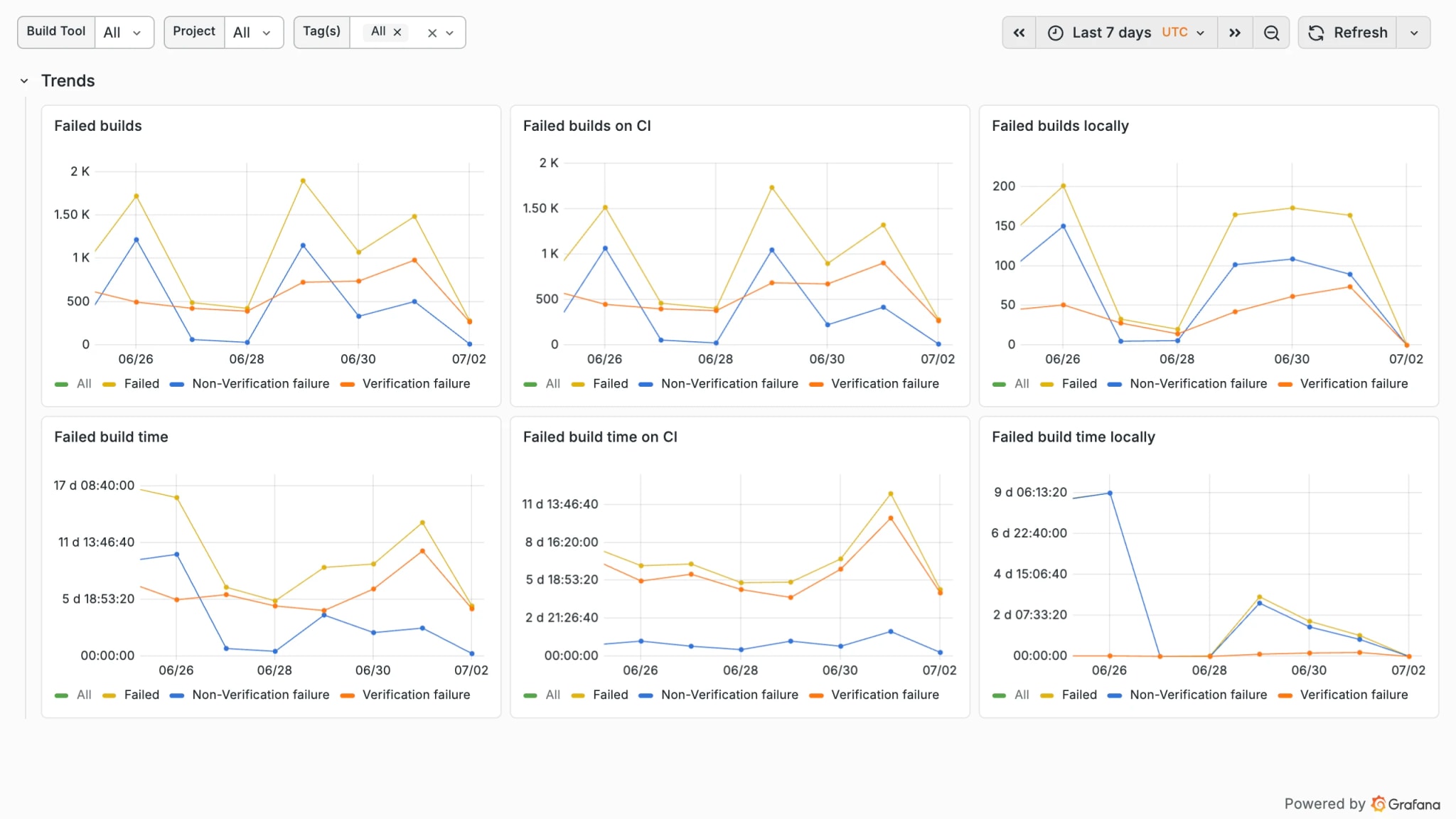
  • Visualize it in Grafana — Develocity ships extensible, pre-built dashboards, detailed on Develocity Analytics.
Develocity Reporting Kit Build Failures Trends dashboard — failed builds and failed build time across all environments, CI, and local, as time-series line charts.

Connect AI agents to your build data through one open protocol

  • Develocity MCP Servers expose your build data over the Model Context Protocol (MCP), the open standard AI agents such as Claude and Codex already speak.
  • Connect once with a standard MCP configuration — no per-tool integration code — and every agent your team runs reaches the same build data.
  • Agents on restricted networks still reach it — a Develocity Edge node proxies the connection, so hybrid and network-policy-controlled deployments work without opening the boundary.
  • Read-only by design and run inside your own network — the MCP Servers hand over facts, never change a build, and keep build data inside your boundary.
An AI agent connected to Develocity over MCP, answering a build question from a Build Scan.

Resources

Visualizing Develocity Data with Prometheus and Grafana
Blog

What's next

Get started today with a 30-day free trial of the entire Develocity product suite.

Start Free Trial

© 2026 Gradle, Inc. Gradle®, Develocity®, Build Scan®, and the Gradlephant logo are registered trademarks of Gradle, Inc.

Get an AI summary of Develocity: